
SAR Equipment: how to locate, communicate and intervene with precision
In Search and Rescue, the difference between a complete kit and a truly effective one lies in the ability of the tools to work as a single operational chain. Locating, communicating, illuminating, recovering, transporting and providing first aid are different actions, yet closely interdependent. For this reason, SAR equipment cannot be read as a mere sum of specialist items: it is a mobile rescue platform that accompanies the operator from the approach to the critical area through to the recovery of the casualty.
Every piece of equipment must be accessible, robust, compatible with the environment and ready for use within the extremely tight timelines that an emergency imposes.
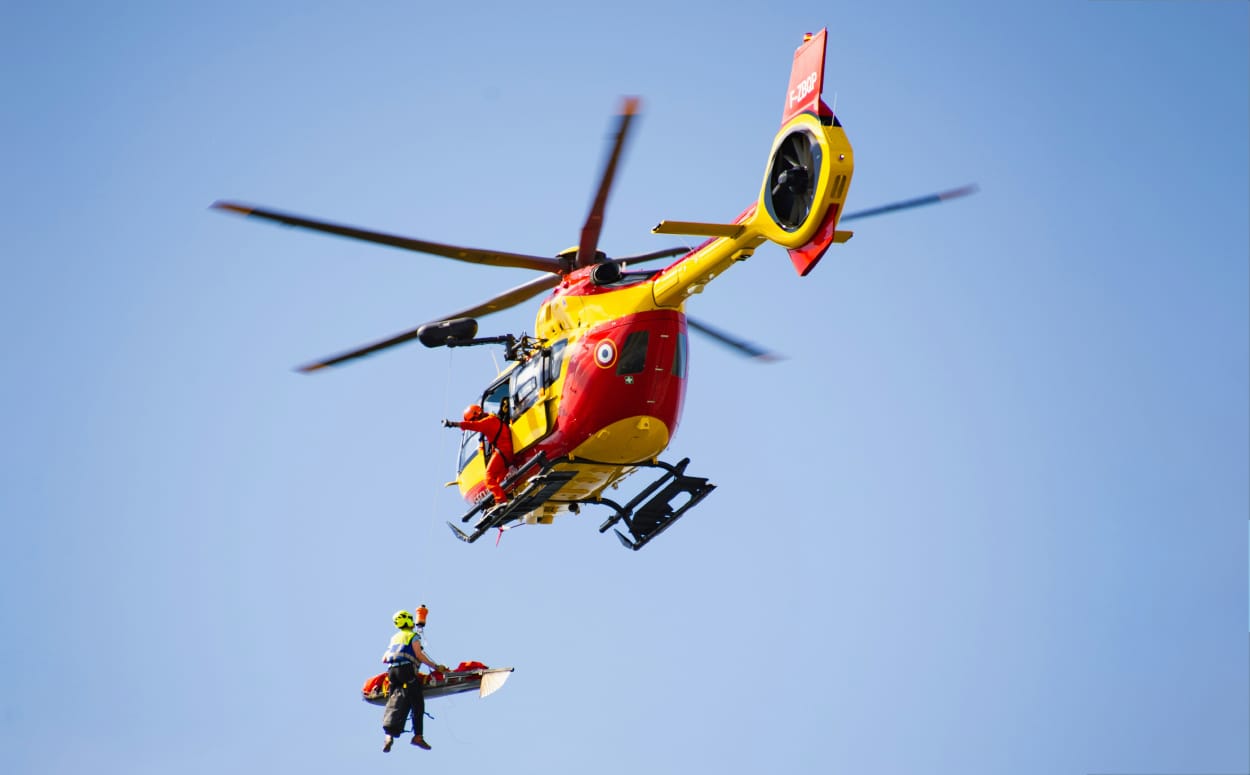
Communication, orientation, and localization: the foundations of every SAR mission.
Communication is the first core element of this equipment. Waterproof portable radios, in the maritime and aeronautical sectors, maintain the link between operators, vehicles and coordination centres even when the context is degraded by wind, rain, water, noise and poor visibility. A reliable radio system reduces the risk of errors, prevents loss of contact and makes it possible to update in real time the position, the victim’s condition and the progress of the operation. In a SAR mission, communicating well means protecting both the rescuer and the casualty.
Immediately afterwards comes orientation. GPS and satellite navigation systems make it possible to reach a search area with precision, share coordinates, track the movements of teams and maintain control of the mission even when visual references are lost. On the open sea, in flooded areas, along jagged coastlines or during night-time operations, this precision limits the dispersal of resources and improves the quality of the response. When every minute carries operational weight, knowing exactly where you are and where you are heading becomes a decisive advantage.
From search to recovery: the equipment that makes the difference in the field
Alongside geographic localisation are dedicated personell and causalty locating systems, useful for tracking operators or missing persons in complex scenarios. Their function is to reduce uncertainty: to narrow the search area, improve coordination and increase the safety of the team. In SAR, in fact, the first reliable piece of data is often the one that determines the outcome of the mission.
Visibility is another essential factor. LED torches, HID torches and chemical lights do not all perform the same function and, precisely for this reason, they must be considered complementary. LED torches are practical, versatile and suited to close-up work; HID torches offer deeper, more powerful beams for searching across wide areas; chemical lights are useful for signalling positions, marking waypoints or making operators and equipment recognisable. Good lighting does not only improve vision: it improves situational awareness and the quality of decisions.
When entering the recovery phase, the equipment must transform speed into control. Throw bags make it possible to get a line to a person in the water immediately and precisely. Rescue knives, designed to cut ropes, straps or tough fabrics quickly and safely, become essential when a victim needs to be freed or an obstacle removed without unnecessary movements.
The correct choice of stretcher, moreover, according to the operational scenario, is an essential element of the chain of rescue. There are mainly two types of specialised stretchers, both designed for technical, maritime and confined-space rescue, offering versatility and control in the most critical conditions.
The first type is the modern technical stretcher, a roll-up, military-derived solution, particularly suited to complex operations. It can be carried, dragged, and lifted both vertically and horizontally, and it is equipped with positive buoyancy for water recovery operations. It is radiolucent – compatible with X-rays and CT scans – resistant to fluids and sand, and supports specific management of pelvic and spinal (C-spine) fractures. Thanks to the improved carrying handles, the cuffs and the triple-locking safety carabiners, it allows transport by 2 or 4 operators. It is light and compact, with a load capacity of up to 200 kg, and can also be fitted into traditional basket stretchers.
The second type is the rigid basket stretcher – the toboggan rescue stretcher – featuring a high-density polyethylene shell with a high-strength aluminium frame, resistant to UV, corrosion and chemical agents. It is ideal for transport over uneven terrain and for helicopter and winch recovery, with a load capacity of 272 kg. It can be integrated with an optional flotation collar to extend its operational capabilities to sea rescue as well.
Completing the equipment are first aid kits, dry bags and waterproof duffel bags. The former allow immediate stabilisation of the patient while awaiting subsequent levels of care; the latter protect electronics, spare parts, medicines and dry clothing from water, mud and dust. These elements too, seemingly secondary, affect the continuity of the mission: a wet tool, an unusable dressing or an inaccessible spare part can disrupt the entire operation at the worst possible moment.
In conclusion, in Search and Rescue, the difference between a complete kit and a truly effective one lies in the ability of the tools to work as one integrated operational chain. For this reason too, the choice of equipment and tools cannot be generic, but must match the scenario, the mission and the needs of the operator.
For SAR operation, Avioconsulting offers specific products for the aeronautical and maritime sectors, always combining sales with a consultancy service that represents one of its key strengths. The aim is not only to provide tools, but to help the partner identify the most suitable solutions to build a coherent, reliable and truly effective in the field set of equipment.