
Sea Rescue Drill: How to Test Operational Readiness
At sea, there is no second chance. When an emergency strikes, the time available to save a life is measured in minutes, and the difference between a successful rescue and a tragedy often depends on automatic actions, well-rehearsed procedures and clear, unambiguous communication. This is why a sea rescue drill is not a mere formality, but a genuine stress test: a complex, high-intensity operation designed to assess the operational readiness of vessel crews, rescue swimmers and ground personnel.
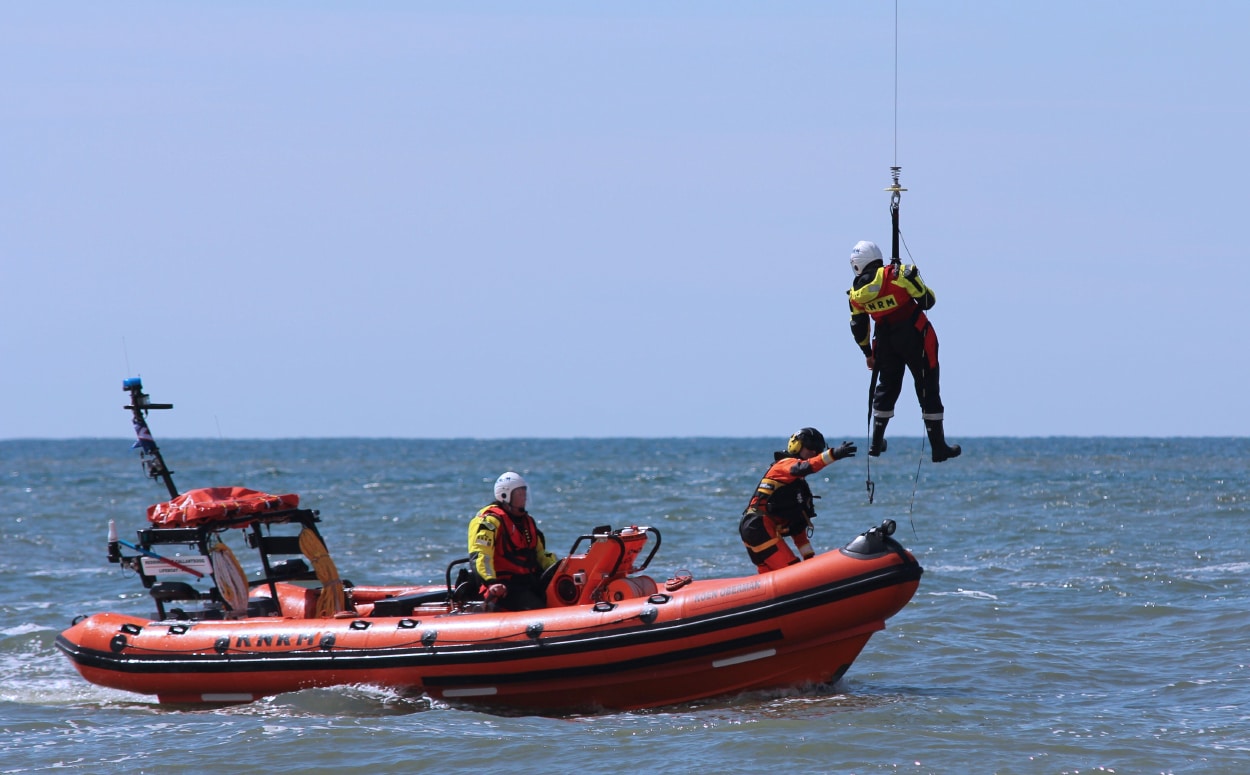
Just as in a real SAR mission, critical scenarios are simulated, including a man overboard (MOB), a shipwreck or a medical evacuation, with one overriding objective: safeguarding human life at sea. In this article, we follow a typical drill step by step, from the initial briefing in port to the final debriefing on the quay.
The Initial Briefing
The day begins in the operations room or aboard the patrol boat. The exercise commander outlines the scenario: a pleasure craft has struck a rock, two people are missing at sea, one person is injured on board and a fire has broken out. Roles are assigned, radio channels are designated, and VHF Channel 16 remains the primary channel for distress and emergency communications. The available assets are then checked, including SAR patrol boats, rigid-hulled inflatable boats (RHIBs) and helicopters.
The briefing also serves as a technical check. The crew verifies that the MOB devices are active and correctly paired with the onboard GPS. If someone falls overboard, these devices can transmit an automatic alert via AIS (Automatic Identification System), making the casualty’s position immediately visible on the displays of nearby vessels, or via DSC (Digital Selective Calling), which alerts VHF stations on standby and transmits the casualty’s position and identification details. Ring buoys, light buoys, smoke floats and recovery nets are also inspected. Nothing is taken for granted, because every piece of unverified equipment represents a variable outside the crew’s control.
The Simulation: Man Overboard
Offshore, without warning, a weighted dummy, with a weight similar to that of an adult, is thrown into the water to simulate a real man-overboard situation.
Whoever witnesses the incident immediately shouts, “Man overboard to starboard!” or “Man overboard to port!” The helmsman presses the MOB button on the GPS to mark the exact position, while one crew member throws a ring buoy fitted with a smoke float to make the dummy easier to spot. Another crew member is assigned as lookout, with the sole responsibility of keeping their eyes on the person in the water at all times. It takes only a few waves for a head at water level to disappear, along with the only visual reference available.
Time is unforgiving: every second can make a difference during a recovery operation. Water temperature is also a critical factor: the lower it is, the more quickly the casualty’s ability to stay afloat and assist in their own recovery deteriorates. Every second lost while locating the casualty means a greater distance to cover, as wind and currents continuously move the actual position away from the marked location.
The crew then carries out the manoeuvres required to return to the incident area while avoiding any risk of striking the casualty with the propeller. Depending on the situation and the casualty’s visibility, the crew may perform an immediate turn, a Williamson turn or an Anderson turn. The final approach takes wind, current and sea conditions into account, with the aim of making the recovery as safe as possible.
The rescue swimmer enters the water, reaches the casualty and secures them using the appropriate recovery device, while the crew on board prepares the recovery net or the fold-down boarding door to bring them on board. Lifting a wet and unresponsive person from a moving vessel is one of the most underestimated and challenging stages of the entire operation.
The Helicopter Rescue Operation
An AW139 helicopter arrives on the scene. The noise is deafening, the downwash churns up the water and reduces visibility, and verbal communication becomes almost impossible. A rescue specialist is lowered by winch to recover the missing person in extremely challenging conditions.
This is the moment when the complexity of the operation reaches its peak: two vehicles are operating on different axes, only a few dozen metres apart, with extremely narrow margins for error. Fuel also becomes a critical factor. The helicopter has limited time to remain at the scene, and every unsuccessful recovery attempt consumes precious minutes that cannot be recovered.
The coordination between the helicopter and the vessels below, including routes, speeds, relative positions and winch timing, determines the success of the operation. This level of coordination cannot be established during an emergency. It is built through joint practice beforehand.
Medical Assistance on the Quay
Once all the casualties have been recovered, the vessels return to port. On the quay, specialised medical personnel set up an area for medical assistance. The exercise includes triage, stabilisation of the injured, management of a case of hypothermia and transfer to hospital.
This is the least spectacular but perhaps the most delicate part of the operation. It ensures that the rescue chain is not interrupted during the transition from sea to land, where the people involved, protocols and responsibilities change.
Debriefing and Analysis
The day ends with an in-depth debriefing. Every phase is analysed, including reaction times, the precision of the manoeuvres, the clarity of radio communications and any critical issues that emerged. Mistakes are discussed openly, because an error made during a drill provides valuable information, whereas the same error during a real mission carries a cost that nobody wants to pay. The objective is not merely to complete the exercise, but to learn from it.
The factors that make all this necessary:
- Speed and precision. The recovery must take place as quickly as possible, with manoeuvres that leave no room for approximation.
- Weather and sea conditions. Exercises can include changing environmental conditions, always within the limits required to protect the people involved, in order to test the response in realistic scenarios.
- Specialisation. Divers, maritime rescue personnel, pilots and flight crews must work together as part of a coordinated system.
Why Constant Testing Is Essential.
A well-conducted simulation puts the entire system under pressure: people, vessels, equipment, procedures and the chain of command. Crews may change, and every procedure may contain a weak point that emerges only under pressure, when conditions become challenging and the available time is limited. Testing regularly is not about proving that you are ready: it is about identifying where you are not yet ready and correcting those weaknesses before they emerge during an emergency in the field.
Avioconsulting: the go-to partner for SAR in Italy
At Avioconsulting, we believe that safety is not a permanent condition, but the result of continuous, verified and documented training. When a real emergency occurs, there is no time left to learn.
This is precisely where Avioconsulting comes in: not merely as a supplier of Search and Rescue equipment, but as a partner able to guide clients in selecting the products best suited to their needs. The company’s strength lies in the consultancy that accompanies every sale, helping clients build an equipment configuration that is genuinely functional, balanced and reliable, in both the aeronautical and maritime sectors.
In a field where every component must integrate with the others without leaving room for uncertainty, the value lies not simply in having the right products available, but in identifying the configuration best suited to each client’s mission.